


Hi everyone!
Last week, a firehose of news drenched everyone in its path, transforming this newsletter into a gobsmacker tome soaking with political import.
So let’s just dive right in…
Around the Legislature
Rustad wins BC Conservative leadership review
BC Conservative leader John Rustad claimed a solid mandate this week following a leadership review. But the numbers are not particularly impressive. Rustad received 70.66 per cent approval, after an almost four-month process that saw voting in each of B.C.’s 93 ridings.
Only 1,268 members voted, or roughly 16 per cent of the estimated BC Conservative membership base.
Put another way: fewer than 900 BC Conservative members in 93 ridings showed up to vote ‘yes’ for Rustad’s leadership over four months, despite him touring the province.
Or consider: New BC Green party leader Emily Lowan picked up 3,189 votes to win her party’s leadership race this week, and the BC Greens have only two MLAs and almost no presence in some parts of the province.
The numbers also show other areas of concern for the Conservatives. Rustad lost in 10 of 93 ridings. In two ridings — Burnaby-New Westminster and Surrey City Centre — not a single BC Conservative showed up to vote at all.
This is less of a surprise when considering how quickly the party pulled candidates together, most were appointed, rather than elected by members since the party had been practically non-existent until months before the election. Many ridings haven’t had active riding associations in decades, if ever.
Still, Rustad presented the leadership results with optimism.
“I look at that as a very solid mandate,” Rustad told reporters on Wednesday.
“When you look at leadership reviews across the country from any political party, that percentage is way above what any other percentage is, from the best of my knowledge, for other political parties when it comes to leadership reviews.”
The leadership process was plagued by scandal, after more than 2,100 fake memberships were cancelled by the party, and at least two dead people were signed up to vote. A party official and two staff have been let go as a result.
Star Conservative critic Elenore Sturko booted from caucus
Shortly after winning his leadership review, Rustad fired star public safety critic Elenore Sturko from caucus. While it was an apparently pre-planned move internally, it rocked the media and political arena.
Rustad accused Sturko of plotting against him, and said he’d caught her doing so at least three times. Sturko denied the charges, saying she had been talking to other MLAs about organizing a vote on Rustad’s leadership for a Monday evening caucus meeting, but was not the only one unhappy.
Sturko’s departure leaves the Official Opposition without its top critic, a former RCMP officer whose prosecution of the BC NDP’s drug policies forced the government to roll back decriminalization, end unwitnessed safe supply and move towards involuntary treatment for people with concurrent mental health and addictions issues.
She’s been so successful, the top bureaucrat in charge of policing inside government launched a police investigation into her to try and uncover her sources.
Still, Sturko had always been an uncomfortable fit for some far-right members of the party’s base, since she defected from BC United 15 months ago. As an outspoken lesbian wife and mother, who advocated strongly for LGBTQ rights, some current and former Conservatives attacked her as “woke.” Some disliked her history as a BC Liberal.
Sturko has been a reckoning force since her first week in the legislative chamber and was recruited to run in a by-election for BC United by former party leader Kevin Falcon. Not known for holding back her opinions, she battles critics on social media and in caucus, and was even caught on camera de-escalating a knife-wielding man in crisis in White Rock in 2023.
“Elenore had a strong voice and that’s going to be a missing part of our caucus,” Surrey-White Rock Conservative MLA Trevor Halford told Global TV, not looking too happy about the situation.
When Sturko defected to the BC Conservatives prior to the 2024 election, it was a momentum-building moment for the party and for Rustad personally. Sturko extended her personal credibility to Rustad’s Conservatives on LGBTQ issues, and opened the door for some voters to give the party another look, substantially neutering some of the criticism from the BC NDP about homophobic and transphobic Conservative policies.
“I hope that John Rustad does the right thing, I hope he resigns,” Sturko said after carting her belongings out of Conservative caucus.
“I hope that he receives pressure from caucus members. I hope they honestly grow a set… and just honestly, have some courage and tell him what we’ve all been talking about in the back back rooms for the last week.”
For an extended explanation from Sturko, check out her interview with Richard Zussman on Global TV.
BC Greens pick radical new leader
BC Greens members had two distinct choices during this week’s leadership race — a young climate activist who wanted a new radical direction, and a middle-aged family doctor who wanted to moderate from climate into the issues of healthcare and housing.
Greens went for the radical. Overwhelmingly.
Emily Lowan, the 25-year-old climate justice activist, ran away with the race, picking up 60.6 per cent of the vote in the first round, compared to 30.3 per cent for Jonathan Kerr. Political science student Adam Bremner-Akins finished a distant third at 2.4 per cent.
“We need a leader who is going to be bold and critical of the governing party,” said Lowan.
Lowan has openly criticized the confidence agreement the two Green MLAs, Jeremy Valeriote and Rob Botterell, signed with the NDP government, saying she wants to re-negotiate it early. Premier David Eby said he’s talked to Lowan and has invited her to a meeting to start talks. The NDP government has a one-vote majority and does not need the two Green MLAs to stay in power, however, it does provide the government a safety net in the legislature.
And now for the main event…
UBCM news extravaganza
Union of BC Municipalities annual conventions bring together mayors and councillors and others from around the province. This year’s was held in the Victoria conference centre across from the legislature.
It was a jam-packed, power-house of a gathering with more stories and news than we can cram into this newsletter, so here are a few highlights…
BC’s expansionist budget
Finance Minister Brenda Bailey may have the worst job in cabinet. Still, she put on her game face and took part in a panel discussion with round after round of punishing statistics and pronouncements on the sorry state of the province’s finances. More than a few mayors walked away from the session, expressing everything from shock, to disbelief, to depression.
For a high-level view of the state of BC’s finances and balanced-budget prospects, try Rob Shaw here and here, and Vaughn Palmer here.
Fumes of fury
Forests Minister Ravi Parmar has been on a tear the last couple weeks, accusing a veteran political columnist of lying (he wasn’t), scolding local officials for criticizing govt policy hurting their residents, to his finale, accusing the president of the Union of BC municipalities of lying (she didn’t) and essentially not doing her job.
“The president of UBCM has said that the only engagement the local governments have gotten on the [Heritage Conservation Act] is three hours at UBCM. That’s not true. That’s simply not true. We have had hundreds of engagement sessions with local governments,” Parmar told reporters last week.
While the Heritage Conservation Act has been under review since about 2019 and gotten feedback from across the province over that span, it only recently became public that Parmar’s ministry has spent the past two years or so negotiating solely with the First Nations Leadership Council on substantive changes to incorporate UNDRIP and DRIPA into the bill. The two parties had “co-developed” the changes, according to ministry staff, and have reached “consensus” on 53 of 57 aspects of the bill, essentially without involving local government.
UCBM president Trish Mandewo simply called Parmar on not involving municipal officials during this co-development process and asked for genuine engagement. Without Mandewo’s pushback, the “process” may well have advanced to legislation without any public engagement at all, in a replay of the NDP’s Land Act debacle.
“Her comments were accurate and represent the voice of local government,” wrote Sparwood Mayor David Wilks on X. “The Premier of the Province should remove Minister Parmar from his role immediately and provide a public apology to Trish Mandewo…”
When asked about it, Eby brushed aside the need for an apology, expressing confidence in Parmar, and saying he has a difficult portfolio.
No doubt he does.
BC’s forestry sector has tanked, mills have closed with thousands of jobs lost, and there are fractious divisions about which of the province’s remaining forests should be logged or protected. Add to that, the contentious Heritage Act changes Parmar’s ministry is bulldozing forward, and his portfolio starts to resemble a powder keg readying to blow the minister on top of it sky high.
Which may partially explain Parmar’s reported short fuse. If someone disagrees with him, he gets very angry instantly, one source revealed, eyebrows raised. All these incidents of him losing his temper and calling people liars is coming off as erratic and unprofessional, never mind keeping ministry staff quite busy on damage control mop-up duty.
Parmar likes to talk about how young he is as if it’s a feature, which sometimes it is. He also summons the memory of his Langford riding predecessor John Horgan as if he’s tracking in his footsteps. If that’s Parmar’s goal, those are tremendously out-sized boots to fill, and he might be mindful of a few things: Horgan had a hot temper, yes, but he was a friend of the working people, particularly in the forestry sector, and he had the confidence and character to apologize when he was wrong.
Saying more by saying less
One side note, elected BC government officials have presented the changes to the Heritage Act as a necessary response to current inefficiencies of the archeological process required before building construction. A fact to which any municipality will attest – Lytton being an egregious example.
But this belies the political motivation driving the last two years of negotiations with the First Nations Leadership Council, which was to incorporate UNDRIP into the act, as was made clear in a detailed presentation by Ministry of Forests staff outlining the changes.
Yet both Parmar and Eby failed to mention this important detail when speaking publicly to the press and local officials this week. Which presented the changes as if they were meeting demands of municipalities, rather than further entrenching the BC NDP reconciliation agenda to expand First Nations statutory decision-making into additional aspects of land use development.
Coastal forestry needs a leg up
Mayors from northern Vancouver Island kicked off the UBCM conference calling on the provincial and federal governments to help the coastal forestry sector following what they say is an estimated 5,400 job losses due to mill closures and provincial public policy since 2022.
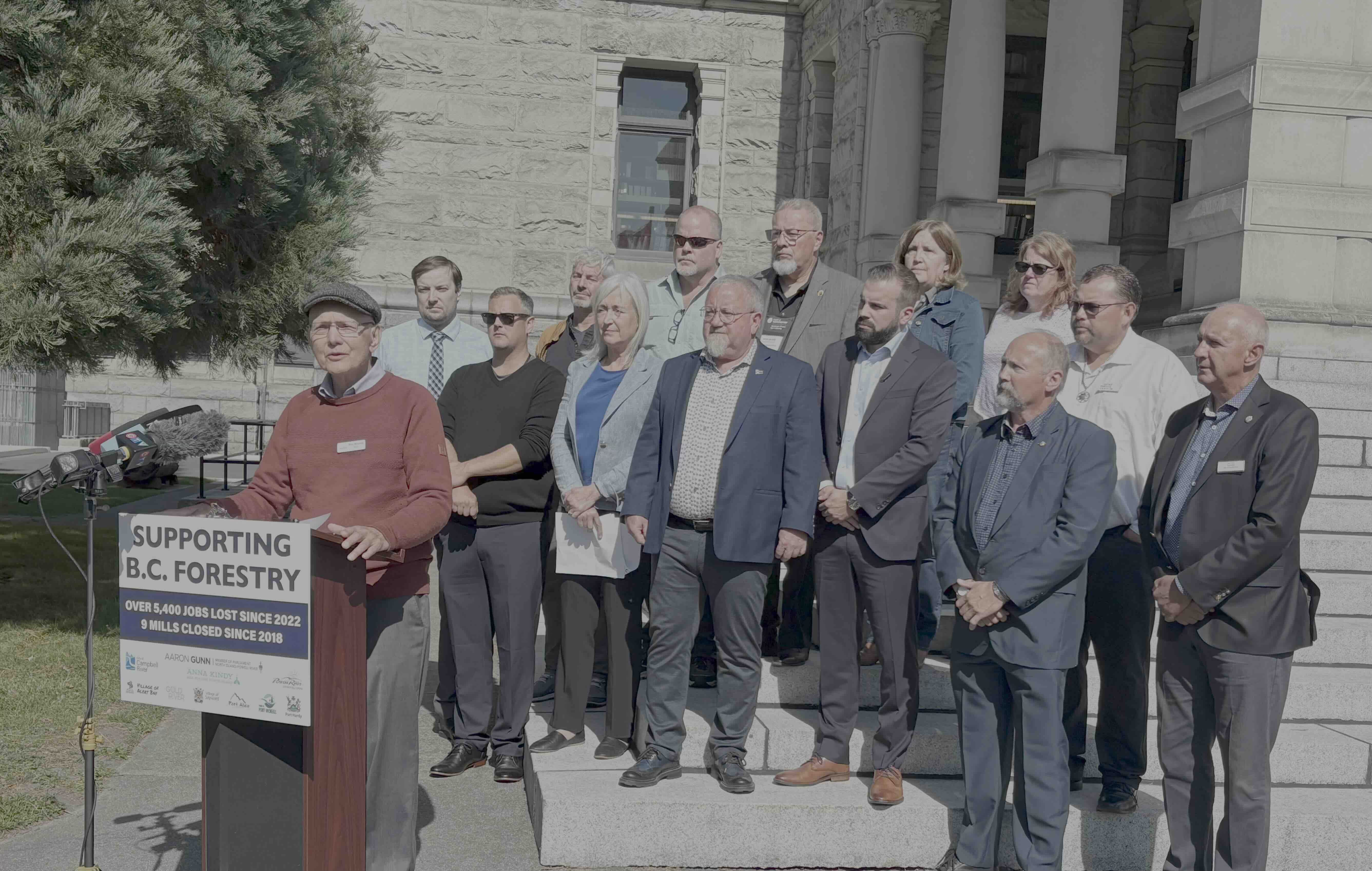
Mayors and a First Nation chief, two MLAs and an MP representing north island communities gathered on the back steps of the legislature, asking government to speed permitting times and ensure a predictable supply of wood for logging.
“BC’s coastal forestry has been uniquely harmed by regulatory uncertainty,” said Campbell River Kermit Dahl. Ministry of Forests initially announced an annual allowable cut of 45 million cubic metres for the region, but the industry is only expected to log 27 million cubic metres, he said. “Now, 45 million is only enough to put the industry on life support… you can imagine how they’re doing at 27 or 28,” Dahl said.
Some Canadian forestry operations are buying US wood and shipping to Canada because it’s cheaper and more reliable than using Canadian logs, the mayor said.
“This building put a stick in the wheel of our forest industry,” said Port McNeill Mayor James Furney. “And we would like to see it removed so that we can go back to sharing our prosperity with the rest of the province.”
There is also concern about the federal industrial carbon tax and the Canadian policy to protect 30 per cent of the Canadian landmass by 3030, said Conservative MP Aaron Gunn, who helped organize the event.
Homeless in Trail
Last year, a 15-year-old girl from Trail went through detox, and while waiting in that “really dangerous gap” between detox and treatment, she used again, and died, said Trail Mayor Colleen Jones.
“It’s so difficult. We have so many gaps in our system right now,” says Jones.
Homelessness is up, drug use is rampant and there is no medical treatment or supportive housing in the community. The closest detox for residents of Trail is in Castlegar, and the nearest treatment is in Vancouver, Kelowna or Kamloops. Whichever one comes up first, they have to take and spend 30 to 60 days out of their community. “Then they come back and they have no supportive housing,” she says.
Jones, along with other mayors in the East and West Kootenays are now calling for a regional approach on homelessness, drug treatment rehabilitation, housing and policing.
“It is so complex because everybody is at a different level of mental health and addiction. And you know, the longer they’re on the streets, the worse it is with brain injury.” The town has an emergency weather response shelter but not supportive housing and no land available. Even people coming to town for jobs have to live in nearby communities, Rossland or Castlegar.
So council is trying to get creative, Jones said. They’re considering rezoning vacant buildings, and also looking developing land outside the municipality.
“Our community is desperate, we need help. We need some support. But then 250 other communities in the province need that same help, that same support. It’s a crisis.”
Mayors united on crime and mandatory care
Mayor Jones is not alone.
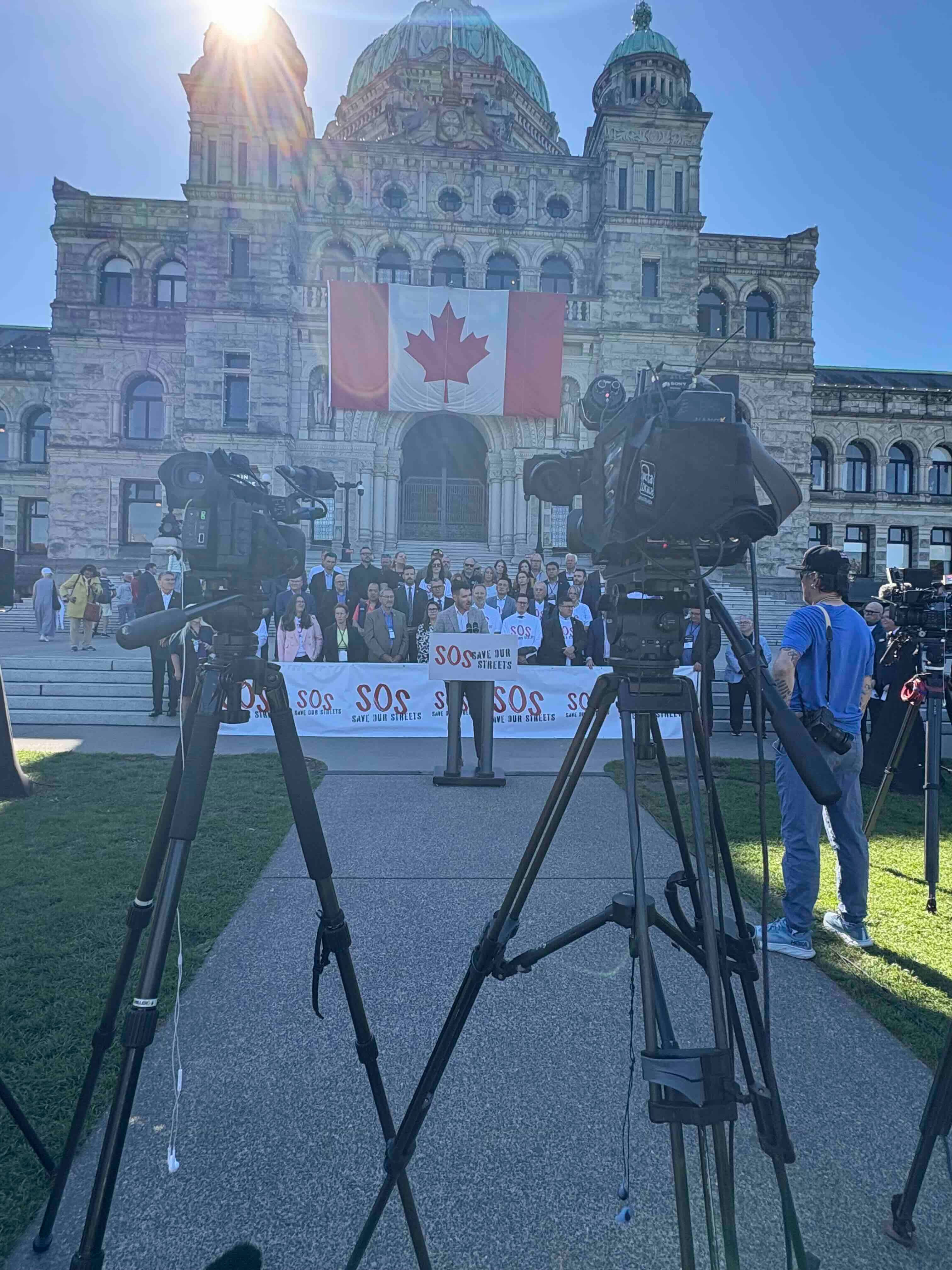
Frustration galvanized in a powerful show of unity when about 50 BC mayors and councillors stood shoulder-to-shoulder in front of the legislative buildings this week, demanding help for those languishing mentally ill and drug addicted on the streets and consequences for the prolific offenders causing chaos, destruction and terror in their communities.
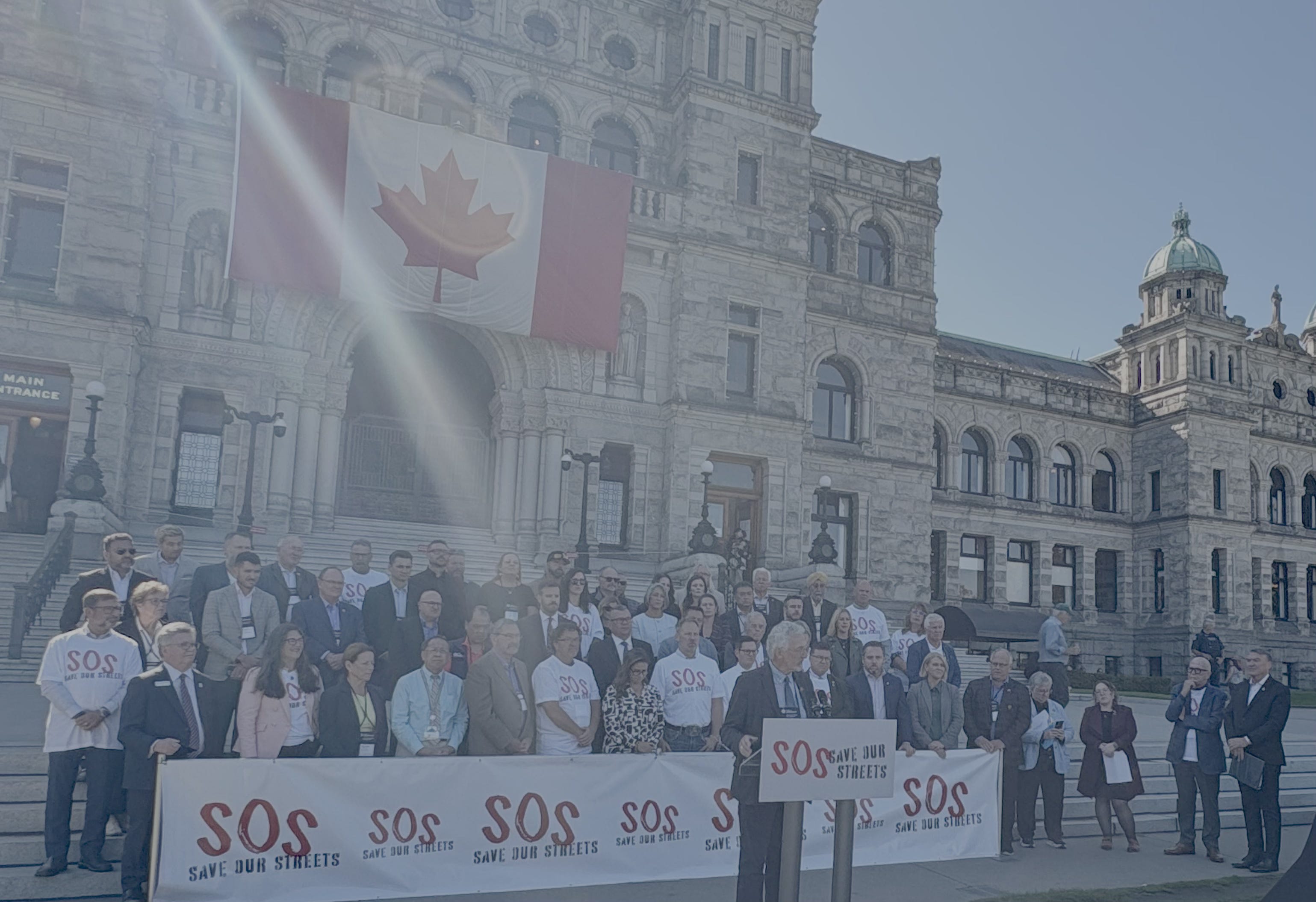
“These issues are reaching a critical point, a tipping point, and we need to set a new course. We need actionable plans, and we need it now, and it needs to be comprehensive, and it needs to incorporate collectively all levels of government, said Save Our Streets CEO and organizer of the mayors’ event, Jess Ketchum.
Chronic offenders have hundreds of police interactions every year in cities across BC and municipalities have incurred huge costs to cover gaps in provincial services. Victoria has redeployed $10.35 million to fight crime, violence and street disorder. Kelowna spent $20 million over the past three years on health, housing, first responders, new bylaw officers and more. Prince George just had its second multi-million-dollar fires this month, gutting two businesses due to downtown street disorder.
Mayors are asking the provincial and federal governments to tighten bail reforms, crack down on repeat offenders and build out involuntary care facilities.
In the Mayors’ words:
“This should be a priority to deal with that crisis when you have the public observing, day in, day out, open shop lifting with apparently no consequences in a criminal court and no hope of reform or help or. Assistance for the individual involved, who is often suffering from a mental health issue, an addiction issue, trauma and more commonly, and sadly, now, a brain injury.
“It just isn’t good enough. We can do better.
“British Columbians want it fixed. Let’s get on with it. Do the right thing for our fellow citizens and do the right thing for our communities.”
– Nanaimo mayor Leonard Krog
“All of our residents are entitled to peaceful, quiet enjoyment in their homes and businesses. But my community doesn’t have this. Bluntly, the current approach to addressing the many aspects of addiction, mental health, unhoused and criminals, is not working. It’s hollowing out our neighborhoods and even our towns.
“We need to find the will to remove [prolific offenders] from our community. That will reduce the demands on our first responders exponentially. We’ve also forgotten the importance of holding people accountable and having real consequences in place when people breach what we consider to be acceptable in our communities.
–John Henderson, mayor of Sechelt
“People are frustrated and quite frankly, they are exhausted. Compassion and patience has been wearing very thin.
“Municipalities were never designed to handle complex challenges like homelessness, unrelated mental health and addictions, and where these two intersect with criminal activity, senior levels of government would like municipalities to step up and advance priorities such as housing and infrastructure… we have been working alongside them to do this, but at the same time, we are left managing the day-to-day consequences of a broken justice system.
“While municipalities can invest in more bylaw, policing and security, municipalities cannot change laws, solve the root causes, or provide the health care services that are needed. That responsibility lies with the province and the federal government.”
–Kelowna Mayor Tom Dyas
“Downtown residents feel frustrated and unsafe and downtown business owners feel besieged.
“We know that underlying issues for street disorder are complex, the availability of housing, the opioid crisis, the mental health crisis and the prevalence of repeat offending all have an impact.”
– Cori Ramsay, Prince George councillor & newly acclaimed UBCM president
“I applaud much of what the provincial government has done around housing. But let’s be clear, it’s taking a really long time, and meanwhile, there are a lot of gaps in service provisions and availability in social services, health services, housing and other areas.
“Local governments cannot sustain this type of investment without dramatic tax increases… We can’t do it alone, and we can’t do it for long, so we’re asking for help.”
–Victoria Mayor Marianne Alto
“From the largest city to the smallest town, we are seeing the same heart-breaking reality, our streets, our businesses, our communities, our people are feeling overwhelmed with crime, with violence and with public disorder, and we need to be very honest about what’s going on here.
“This is the predictable outcome of the trajectory that we’ve been on. It is the result of a system that responds with cold indifference to the concerns of victims, a system that prioritizes release over detention, ignores the principle of accountability, and spends too much time explaining away bad behavior. It’s also a system that leaves people suffering from mental illness and addiction where it finds them and then has the audacity to call that compassion.
“It’s not compassion, it’s cruelty.”
–Brad West, Mayor of Port Coquitlam
A glimmer of hope
In response to the effectiveness of a united municipal front, Premier Eby accelerated his government’s decision to build up involuntary care beds, announcing 100 new beds in Prince George and Surrey, during his keynote address to hundreds of mayors and councillors on Friday.
This is a long-time coming, and it’s still desperately short of provincial demand, but credit where it’s due – the premier pulled the trigger and made it happen (after his scientific advisor, a northern psychiatrist and many others laid the ground work).
So kudos to the BC NDP.
News of the 100 new beds was enthusiastically embraced by every mayor who now sees it as a sign that the BC NDP may finally be inching toward building capacity in the province’s nearly non-existent involuntary residential treatment system.
It’s a strong step forward and Eby says there are more on the way.
While these latest beds will be narrowly targeted for people with the most severe addictions, mental health and brain injuries, they are expected to have an outsized reductive effect on street disorder while freeing up hospital resources.
We’ll have more to share on this in the next couple days on what it will mean for the north and elsewhere.
And because no UBCM convention summary could possibly be complete without a nod to the Pouce, there’s this…
Give ‘em their blinkin’ light
For fourteen years, the tenacious council of Pouce Coupe has tried to get a blinking light at the crosswalk traversing the regional highway that cuts through their community.
To no end.
Last year, they took the matter to their coveted 15-minute meeting with the minister of transportation at UBCM annual convention. The minister didn’t show up. So council members pitched his staff and were told essentially no way, no how. Traffic studies had been done, there weren’t enough feet slapping the pavement, demand did not meet the threshold needed for a blinking light, give it up already, finito.
Nevermind the study was done over Christmas holidays in -40C. Since village residents generally use the crosswalk to get to the school, hockey rink or playing field on the other side, foot traffic over Christmas in winter deep freeze was not typical usage.
This year, despite being warned off revisiting the issue ever again in their UBCM minister’s meeting, councillors gave it one more shot.
They threw everything they had (including a cinnamon bun) at Transportation Minister Mike Farnworth: Residents really want it, it’s dangerous without it, the village has the money to pay for it, council just needs ministry approval to install it.
When they’d done their impassioned plea, the councillors paused, waiting for the minister’s response.
At which point, he apparently said, “You want a button?”
As to whether Farnworth gave final approval or not, the councillors are not sure. He apparently nodded at staff in the room, but the meaning of the nod is unclear.
An inquiry to the minister’s office came up inconclusive.
“Ministry staff will be following up with the village after UBCM to discuss this item in greater detail to determine what options are available,” a spokeswoman emailed back.
Since then, councillors couldn’t help but notice the proliferation of blinking buttons all over the province’s capital, even where they don’t seem to be needed, flashing buttons wink from nearly every corner.
For god’s sake, Minister, give Pouce Coupians their blinkin’ button!
QUOTE of the week:
“We did not get here by accident, and if deliberate policy decisions by government got us here, then you know damn well that government action can begin to turn this around. So my message is very simple, on sentencing, on bail reform, on involuntary care, on all of this, we know what needs to happen, so government needs to stop talking about it and start doing it.” –Port Coquitlam Mayor Brad West